
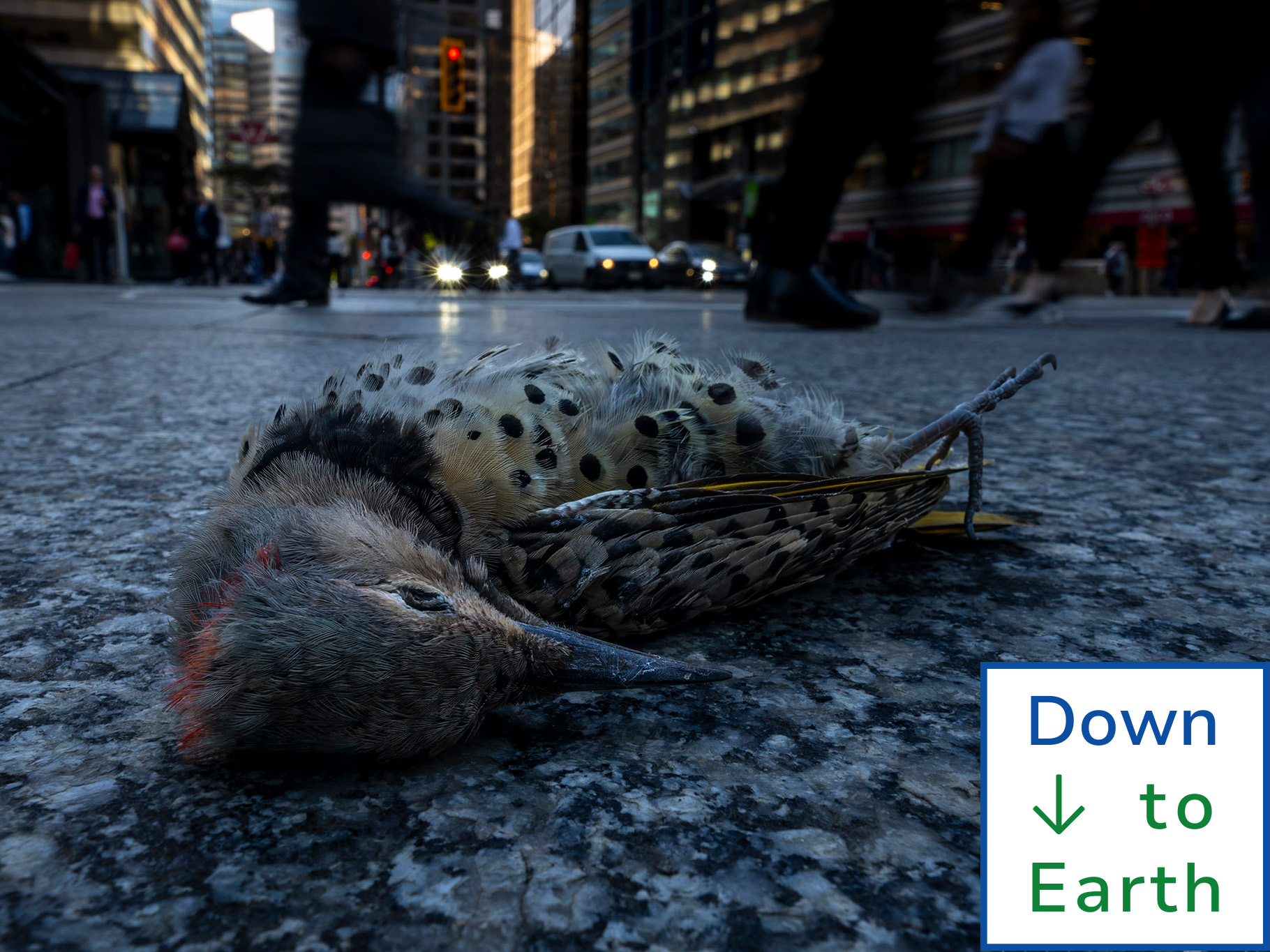
Silent Goodbye: A Flicker Lost in the City. Photo by Patricia Homonylo, Bird Photographer of the Year 2024 (@patriciahomonylophoto). Patricia’s winning photo, When Worlds Collide, is shown further below.
By Gale A. Kirking
Editor-in-Chief at BlueGreen
Most probably, we nearly all have heard the sickening THUMP! of a bird unknowingly flying straight into a glass window. The soft-feathered innocent drops straight to the ground, perhaps leaving a smudge of downy plumage and of bodily fluids on the glass. Very likely, that bird died almost instantly. Possibly, it recovered sufficiently so as to fly or crawl away to die somewhere else. Maybe the neighbor’s outdoor cat finished off the bird.
These fatal collisions occur millions of times every day. Millions. We occasionally hear them, almost never see them, and, in most cases, do nothing in response to prevent them from recurring. Such a collision quite probably has occurred more than once in the past year at your house or apartment building or office window, regardless of whether you heard or saw it. Very often, in fact, these strikes leave no physical evidence behind whatsoever, so the resident likely will never know.
Wherever glass and birds co-exist, bird–glass collisions take place. Unless designed or outfitted specifically to prevent such events, essentially all buildings with windows kill birds. That is true whether the building is a small, single-story family bungalow or a massive skyscraper. Where proper design and building materials are used, however, bird–glass collisions can be greatly reduced.
There are things each and every one of us can do to diminish these losses, including, but not limited to, making our own windows visible to birds (click here to begin learning specifically how), setting a good example of bird-safety consciousness for our friends and neighbors, and pressuring our public officials to mandate bird-safe building designs.
This essay will provide a comprehensive overview of this deadly serious problem while pointing to mitigations and solutions. The subject of bird–glass collisions is one about which I have learned a great deal over the past year. My education in this area began upon my being introduced to Patricia Homonylo, an award-winning conservation photojournalist and filmmaker who had been named Wildlife Photographer of the Year 2024 and Bird Photographer of the Year for her visual capturing of the annual dead bird layout conducted by FLAP Canada, an organization devoted to publicizing and reducing these bird deaths. I continued to learn when Patricia introduced me to Michael Mesure, co-founder and Executive Director of FLAP. Michael, then, directed me to Professor Daniel Klem, Jr., a biologist who has devoted his entire career of more than 50 years to the problematics of bird–glass collisions.
I will introduce you to Patricia, Michael, and Professor Klem shortly.
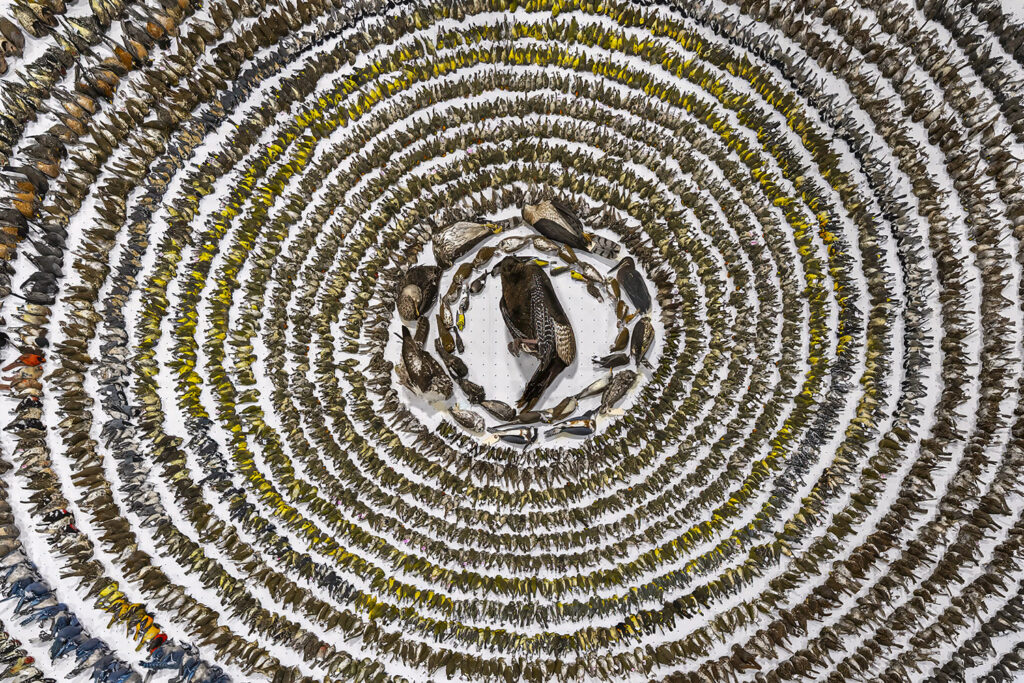
When Worlds Collide, by Patricia Homonylo, Bird Photographer of the Year 2024, presenting FLAP Canada’s annual dead bird layout of building collision victims.
A personal perspective
Like most human beings, surely, I love and admire birds. I have heard the THUMP! of bird hitting glass more than once in my life. Why, I ask myself now, could I have experienced that and not given a thought to whether or not it would have been preventable? I know better today and I want you to know better, too.
Coincidentally, while I was learning about all this, my wife and I were in the process last year of putting all new triple-pane windows into our house. It had not yet occurred to us to have the external panes consist of bird-safe glass that would have made our new windows visible to birds. My strong advice to readers contemplating an investment into new windows is to buy bird-safe glass. There are various options, but, knowing what I know now and were I to do it again, I would buy so-called fritted glass, which is permanently imprinted with dots or other patterns causing birds to perceive the glass not as thin air through which to fly at full speed but as a solid barrier to be avoided.
“My strong advice to readers contemplating an investment into new windows is to buy bird-safe glass.”
– the author
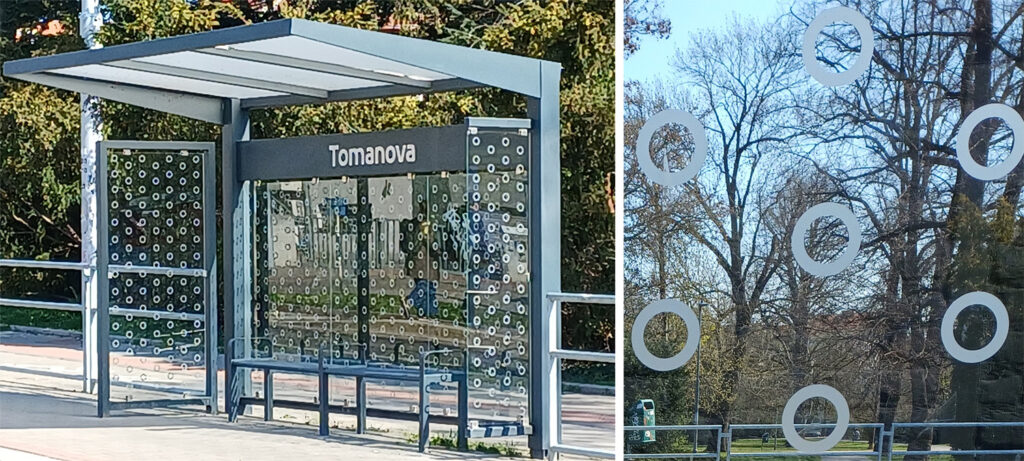
Alas, we learned just a few months too late. Subsequently, after some research, we decided to apply a matrix of UV-reflective, circular stickers to our new windows’ external surfaces. Unlike humans, birds are able to see ultraviolet light and so these decals should make our windows visible to our feathered friends. Transparent (albeit not invisible) to the human eye, such stickers are commonly available today in various types and patterns. In our case, we do not regard this as our permanent solution but hope it has made our house safer for birds while we explore other options. A problem with the UV light decals is that their UV reflectiveness wears out after a few months’ time and so they need to be peeled off and replaced. We are strongly considering to apply a more durably affixed appliqué that mimics fritted glass and which the city where we live has applied to glass-walled public transport shelters (see image below).
Brno public transport shelter with bird-safe glass near the author’s house
I wonder how many birds died at our house in the several weeks between our installing the new windows and applying the protection. During that interim, my wife, Regina, and I both heard one collision with our spacious and beautiful dining room window facing out into the backyard. That motivated Regina to work diligently through one whole weekend to apply the UV-reflective decals on all windows. I found a dead songbird a few weeks later behind our woodpile, not far from the dining room window. Presumably, it had crawled there to die after smashing into our new glass. Perhaps that was the collision we had heard. Possibly it was one of several of which we were unaware.
Context and magnitude of the problem
As I related in another of my essays about a year ago (see Earth Day at 55: A look back to 1970, a look around today), it has been estimated that the bird population in the U.S. alone fell by 29% between 1970 and 2019. We have no reason to believe that the decline has not continued. Moreover, a shrinking bird population is almost certainly a global phenomenon. It is a multidimensional ongoing tragedy caused entirely by human beings.
Our destruction of birds’ natural habitats is, by far, the most important cause of declining bird populations generally. Moreover, this forces birds to live in close proximity to humans and to share living spaces with us. Many bird species might appear to manage this coexistence with humans quite successfully, and some no doubt do, but humans create a multitude of hazards for our winged neighbors.
“Most (albeit not all) experts agree that feral and outdoor (free-roaming) housecats constitute the number-one single human-related cause of bird deaths… The second-largest human cause of bird deaths is buildings.”
Scientific estimates of annual bird deaths due to human causes range very widely, but actual bird kills attributable to people likely exceed 3 billion annually in the U.S. and Canada alone. Yes, that’s billion with a b! Worldwide, the total must be several times that number. Most (albeit not all) experts agree that feral and outdoor (free-roaming) housecats constitute the number-one single human-related cause of bird deaths. Cat lovers who also care about birds would be well advised to keep their pets indoors. The second-largest human cause of bird deaths is buildings, and particularly glass. Other major causes include automobiles and other motor vehicles, power lines (due to collisions plus electrocutions), collisions with communication (especially radio and television) towers and wind turbines, and poisoning by agricultural chemicals. Each of these causes individually is responsible for millions of wild bird deaths annually. (I should note that Professor Klem is one leading expert who strongly disagrees with the ordering of cats as worst offender and windows as second. Both are very serious problems, he agrees, but Klem feels windows kill more birds than do cats.)
But the focus here will be on windows
Let’s begin with a bit of background information that, having heard or read it, may seem entirely obvious to all of us. From a bird’s perspective, clear and transparent glass looks like nothing at all. It is “Solid Air,” to borrow the term Professor Klem has chosen for a comprehensive book he wrote on this subject. Why would a bird not choose – fatally – to fly through it? Sometimes glass is not transparent but reflective. It may be specifically designed to be mirrorlike or be reflective just during certain times of the day. And what it reflects is sky, leafy trees, and other beautifully innocent and natural phenomena apparently to soar through or to.
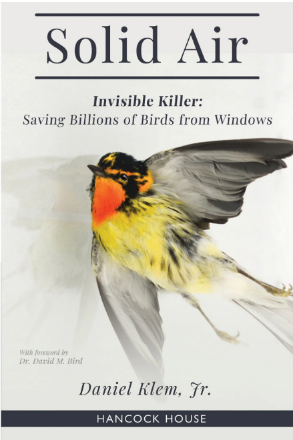 |
“The primary purpose of this book is to stop the unintended and unwanted killing of the defenseless innocent, those that have no voice or other means to protect themselves from an invisible killer. I hope to enlist the power of citizens everywhere to help solve this problem. The goal is to inform, persuade, and incite a change in human behavior to produce a life-saving change in bird behavior.”
– Professor Daniel Klem, Jr. |
Another aspect that is important but not yet so well understood (and a subject of some controversy among scientists) concerns nighttime light emissions. This appears to be most important in relation to large urban areas and during birds’ spring and autumn migration seasons. Many bird species, and especially small songbirds, fly at night when migrating. Artificial light at night (known among environmental scientists as “ALAN”) emitted by urban areas can confuse migrating birds and also cause more collisions with buildings. Indeed, the name of FLAP, the organization Michael Mesure cofounded, is an acronym for Fatal Light Awareness Program. FLAP and other bird advocacy groups promote turning out the lights in large and tall urban buildings during migration seasons.
A study published in 2019 (see Loss et al. 2019 in the “For more information” list at the end of this article) based upon monitoring of bird collisions at 21 buildings in a metropolitan downtown found that a) proportion of glass in the building exterior, and b) proportion of vegetation cover within 50 or 100 meters of the buildings were the two main factors affecting bird collisions. The third major factor (albeit substantially weaker than the first two) was the proportion of glass area that was lighted at night.
Buildings of all sizes kill birds
Putting aside for now light pollution, which is a more complicated matter, the key to making windows, building designs, and communities safer for birds is to help the animals see threats as they really are. Birds are not stupid. They do not fly head-on at full speed into hard and fixed objects because they have a death wish. (That said, some birds do at times attack their own images as reflected in glass, Klem explains, but that is because they think they are confronting another bird intruding on their territories. The image-fighting birds can beat themselves up quite brutally in the process, he says, but these self-encounters are rarely, if ever, fatal.)
Although individual skyscrapers and other large urban buildings containing lots of glass undoubtedly kill many birds, such structures are relatively few in number. In a sophisticated meta study (analyzing collectively findings from 23 earlier studies) published in 2014, Loss et al. (see “For more information” list) estimated that fewer than 1% of fatal bird–building collisions in the United States should be attributed to buildings of 12 stories and taller. They calculated that some 44% of such collisions involved individual houses 1–3 stories high, and the remaining 56% related to low-rise nonresidential and residential buildings 4–11 stories tall.
Making your windows apparent: What doesn’t work
The quickest way for you personally to make a difference is to mark your windows. I think the best starting point is to recognize up front what will not work. There is a widely spread myth that placing a large decal shaped like a hawk, falcon or other raptor in just one corner of a window will prevent bird strikes. Well, it turns out that is dead wrong. It is scientifically proven not to work. What is important is to mark the entire window.
As I’m writing this, I just watched a YouTube video by a very nice and well-meaning lady who is showing her followers how to stick pretty bird decals on the inside of her big, garden- and forest-facing picture window through which she watches abundant birds at her large feeders about 25 feet (7–8 meters) away. When she gets done, the lady has a beautiful menagerie of several dozen life-size, realistically colored songbirds visible (to humans, at least) inside and out on her still highly reflective window. Sorry to say it, but this won’t work either. Windows need to be marked on the outside surface. It does no good on the inside, and I’m not sure that anybody has done research on whether images of realistic-looking birds in flight plastered on any window surface will discourage birds from flying into that menagerie.
Finally, the pleasant bird-watching lady has her feeders situated in a very dangerous place more or less guaranteed to encourage the objects of her fascination to continue flying smack! into her picture window on a fairly regular basis. I’ll say more on bird feeder placement in a moment.
Making your windows apparent: What does work
Based upon the research of Professor Klem and others, as reported in his book Solid Air and in his publicly accessible scientific papers, here are some scientifically proven points:
In marking windows, what’s important is not so much the material that is used as is its placement. “Patterns that effectively deter bird strikes must uniformly cover the surface of a window, and the elements making up the pattern must follow the 2 × 4 Rule,” Klem writes. “The 2 × 4 Rule states that elements making up a pattern must be separated by 2 inches (5 cm) if oriented in horizontal rows and by 4 inches (10 cm) if oriented in vertical columns. Reducing the spacing between vertical pattern elements to that of horizontal elements results in modifying the 2 × 4 Rule to the 2 × 2 Rule.”
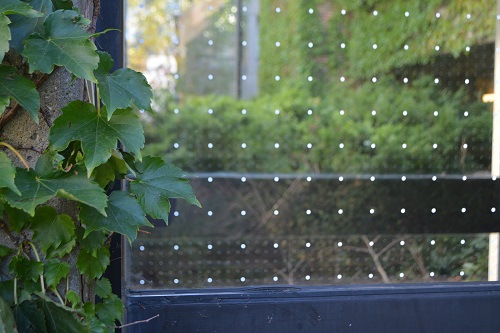
A bird-safe window marked according to the 2” × 2” (5 cm × 5 cm) rule
Photo credit: FLAP Canada.
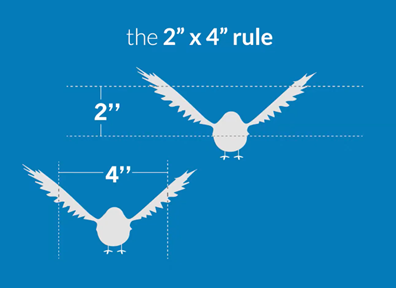
Illustration of the 2” × 4” (5 cm × 10 cm) rule
Image credit: American Bird Conservancy.
For new windows, best of all is to utilize specifically designed bird-safe glass that is acid-etched or ceramic-fritted with the patterns permanently ingrained. Typically, the bird-visible elements are dots, geometric patterns, lines, or vegetation-like designs. The available range of aesthetically acceptable options is these days growing continuously. For existing windows, Klem notes, soap, tempera paint, films, and strings can be used. Adhesive decals reflecting UV light and therefore visible to birds but transparent to humans have become readily available by mail order. As I described above, however, the UV stickers do lose their UV reflectivity over time. I want to reemphasize that the decals or other markers must be applied to the outside surface of the glass.
External window screens are also effective, Klem reports, and almost any kind of visible grille, louver, or netting will work so long as it is mounted on the outside and follows the 2” × 2” (5 cm × 5 cm) or 2” × 4” (5 cm × 10 cm) spacing rule.
Bird feeders and other attractants
Wherever there are bird feeders, berry-producing trees or bushes, or other bird-attracting objects, Klem says, danger zones for birds are created if windows are also nearby. Moreover, the danger is very high if trees, shrubbery, or other vegetation are situated near unmarked windows. One might be surprised to learn that the safest place for bird feeders is actually right up next to windows – within 3 feet (ca 1 meter). Our instinct might be to move our feeders 25 or 35 feet (8–10 meters) away from the windows, but, once again, our intuition in that regard would be wrong.
The safest place for bird feeders is actually right up next to windows – within 3 feet (ca 1 meter).
The reason for this counterintuitive finding, Klem explains, is that flying birds incoming to a feeder are slowing their flight. If they do strike a window at low speed, they may be dazed but not annihilated. Also, if a bird hits a window when departing a closely placed feeder, it will not yet have gathered sufficient momentum to cause itself mortal injury.
“My studies have repeatedly revealed that beyond 1 meter (3.3 feet), there is really no safe distance to place an attractant away from the window surface,” Klem explains. “Many writers addressing the issue of where to place feeding stations near windows have wrongly interpreted the results of our feeder placement experiment to mean it is safe to place attractants greater than 10 meters (33 feet) from a window surface… Birds are at risk of a lethal strike if they can enter the danger zone from any distance from the window surface.” In any case, Klem explains, good and proper marking of external window surfaces will largely eliminate strikes no matter where feeders are placed. Birds know how to take care of themselves if they can just see what they need to watch out for.
Public buildings, public policy
Since learning more deeply about bird–glass collisions, I no longer can walk through an urban built environment without looking constantly at buildings, skywalks, sound barriers, public transportation shelters, and every other imaginable type of glass-containing structure. I have learned that more and more governments, mostly at local levels, are passing laws and creating building design standards to address this problem. Bird-loving activists (and maybe you, the reader, will become one of these if you are not already) now have a good number of model laws and codes to propose and for which to advocate. I will share with you more about that in a moment, but first I’d like to relate what’s going on around me where I live.
My wife and I reside with our teenagers in Brno, Czech Republic, where we utilize on a daily basis this mid-size metropolitan area’s extensive integrated public transportation system of buses, electric trolleybuses, and trams (i.e., streetcars). We have noted an increasing emergence at public transport stops of modern, glass transportation shelters featuring a diverse range of bird-safe glass designs. We reached out to Monika Knězková, who heads the Nature and Landscape Conservation Section for the City of Brno’s Department of the Environment. We asked her what prompted the introduction of bird-safe glass at public transit stops in Brno.
“It was practical experience,” Knězková related, “because birds were colliding with glass surfaces not only at public transit stops but also on building facades, glass balconies, glass railings, and similar structures.” Although these efforts to protect birds are increasingly visible to the public, she said this is not something entirely new.
“The City of Brno has been addressing this issue for at least 20 years as part of its reviews of construction projects,” Knězková told us. “Investors have always been advised that glass surfaces can be dangerous due to bird collisions and that these surfaces need to be made safe.” In 2019, she noted, the city architect’s office issued a document, Principles for the Design of Public Spaces, which, among other things and at the request of the municipality’s Department of the Environment, calls for the protection of glass walls on public transit shelters against bird collisions and outlines brief guidelines for achieving functional protection of glass surfaces. Although the city utilizes some sheet glass products that incorporate bird safety features as a built-in element, more commonly the city is using hard-wearing decals to mark the glass.
Furthermore, Knězková pointed out that the Czech Republic has a national law (Act No. 114/1992 Coll., on the Protection of Nature and the Landscape) specifically stating that, when using structures, it is necessary to proceed in such a way as to prevent the unnecessary injury or death of animals. Another section of that law prohibits the intentional killing of wild birds.
To date, Brno has not undertaken any scientific study of the bird safety standards’ effectiveness, but Knězková reported that empirical evidence suggests the city’s efforts are paying off. Her office has received no reports of dead birds in areas where glass surfaces at transit shelters are properly protected. Moreover, Knězková added, residents can report bus stops presenting danger to birds at the website of the Czech Ornithological Society (www.birdlife.cz).
“I believe that public reactions have been largely positive,” she remarked. “I am not aware of any instances where someone has complained about the use of decals on glass, for example, on the grounds that they detract from a building’s architectural appearance. It is (only some of) the architects themselves who tend to have a problem with this.”
While Brno is our main residence today, I am originally from Wisconsin and we maintain a small residence also in Madison, the capital city of that U.S. state. I was pleased while pursuing my research for this essay to learn that the City of Madison’s Common Council had in 2020 unanimously passed a Bird-Safe Glass Ordinance. Madison was not the first to pass such a law, nor is its ordinance the best in existence. Toronto, Ontario, Canada (home of Patricia Homonylo and Michael Mesure, who I’ll come back to shortly) was probably the first local government on the North American Continent to enact mandatory and comprehensive bird-friendly building codes (in 2010), closely followed by San Francisco, California in the U.S. (in 2011).
Model legal codes and building standards
Even as the science and practice of making structures safe for birds continue to evolve and improve, there already exist today numerous model codes, standards, and guidelines from Canada, the U.S., the European Union, and surely other parts of the world. Local activists and officials in any municipality, community, or jurisdiction can find guidance in the statutory and information materials freely available today. In the box below (see Model bird-safety codes and standards), I provide links to some of the best of these. I will briefly discuss just a few of them.
CSA A460:19 (National Standard of Canada), Bird-Friendly Building Design is a national standard that covers glazing, structural design, lighting, and other considerations. It has been widely adopted, replicated, and emulated in Canada and beyond. CSA A460’s recommendations are equally valuable for large and small, public and private buildings. The standard can be read online at no charge. Its Annex C reviews and provides links to other legal and standard-setting bird protection initiatives in Canada and the U.S. Annex F is a wide-ranging bibliography of scientific and expert information resources.
In 2010, the City of Toronto, Canada established its Toronto Green Standard (TGS) sustainable design and performance requirements for new private and city-owned built developments. Bird safety is integral to these requirements, which consist in two tiers, Tier 1 being mandatory and Tier 2 voluntary. Aiming to reduce bird deaths day and night, the city has produced two extensive and very useful information documents – Best Practices for Bird-Friendly Glass and Best Practices for Effective Lighting – the guidelines within which are mandatory under TGS Tier 1.
An excellent reference for those interested in writing and/or advocating for local codes or ordinances or a broader legal basis for bird safety, the Yale Bird-Friendly Building Initiative’s Database of U.S. Bird-Friendly Building Policies compares and provides links to legal and policy documentation in 30 U.S. jurisdictions. Also useful is the Birds Directive (Directive 79/409/EEC) of the European Union, constituting the core of a major body of law in Europe.
| Model bird-safety codes and standards
Presented here are some of the most important municipal, national (Canada), and multinational (European Union) legal codes and design standards aiming to prevent bird–glass collisions.
|
People can make a difference
There is little birds can do to protect themselves from the dangers that humankind puts before them. It is up to us, human beings, to decide whether we, with our love of transparent and reflective glass, continue to slaughter birds on a massive and quite probably escalating scale or we take meaningful steps to turn that trajectory. While recognizing that there are many nature and bird lovers across the world taking this problem very seriously, I want to tell the stories of three individuals who have devoted their lives to saving those of birds and who inspired me to write, publish, and promote this article.
Patricia Homonylo, wildlife photographer and film-maker
When Worlds Collide, the award-winning image by Patricia Homonylo, Bird Photographer of the Year 2024, is not your typical wildlife photo. It is disturbing, because it combines great beauty with immense tragedy. And that’s the point.
“When people see this image,” Patricia remarks, “they can’t not see it anymore. It will change the way they see windows forever.”
The subject of this photograph and an accompanying short film by the same name is the annual layout of nearly 4,000 dead birds by FLAP Canada, an organization devoted to publicizing and reducing bird deaths caused by collisions with windows. Patricia is honored and pleased for the recognition that the picture has brought to her personally, to FLAP, to the FLAP volunteers, and to the birds, but the photo fills her with sadness. She wants the viewer to feel and to share some of her grief. She hopes that will motivate individuals to take steps personally to prevent such deaths, because there are things all of us can do.
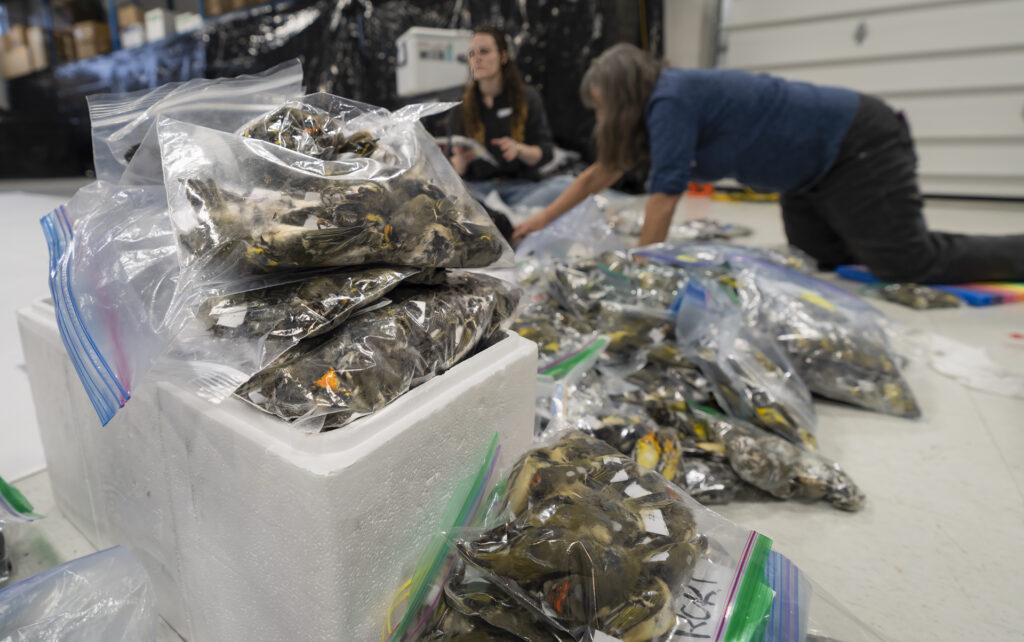 |
A scene from When Worlds Collide – Behind the Scenes (click to view), a short film by Patricia Homonylo, Bird Photographer of the Year 2024. Image is of volunteers working on FLAP Canada’s annual dead bird layout. Photo credit: @patriciahomonylophoto. |
The vast majority of the birds in When Worlds Collide were killed when they struck glass in the City of Toronto, where Patricia lives. Their bodies were recovered – and a minority (about 30% of those recovered) of still-living birds rescued for rehabilitation and release – by FLAP volunteers who daily set out at dawn to gather the injured, dead, and dying birds. Patricia understands that work very well, because she herself patrolled with other early morning volunteers for several years before shooting this photo.
On the weekend I reach out to the award-winning wildlife photographer and film-maker, she was preoccupied in a rescue effort concerning a colony of Common Terns (a medium-sized seabird resembling and related to gulls) that had grown up over the past several years atop a water filtration plant in her neighborhood.
The rooftop colony, she explains, “is exposed to the sun. It has no protection. There’s no beach for the birds to go to, so they’ve created a colony up there. The chicks fall off the rooftop, and they get burned to death up there.” Together with some friends, Patricia had raised some money and had created shelters that they wanted to place onto the roof. Of course, they don’t own the roof, and their efforts to gain access to it were not going well.
Patricia says that for as long as she can remember she has been concerned about the environment and animals and rescue efforts. If she were a veterinarian or a scientist, perhaps she would contribute differently, but she’s an artist, and that’s the skillset she brings to the pursuit of her passion.
Clearly, her artistry combining beauty and horror in this case has been very successful. She recognizes, of course, that the image is also shocking.
“I want people to be shocked,” Patricia remarks. “I want people to be angry. I want people to be sad. That’s what good art can do. It can move people. And this image has done that…Even beyond my imagination it has excelled and traveled, and I just want it to keep going. And I always want to give Bird Photographer of the Year the credit for choosing this.”
Perhaps it would have been easier, she allows, for the jury to pick an image of a soaring eagle or a perfectly pretty songbird. Instead, the judges decided to demonstrate the importance of conservation imagery to “show the world what they don’t want to look at.” Patricia says she is very proud, too, of the fact that she is only the second woman to have been named Bird Photographer of the Year.
Of course, having been honored in this way, she finds herself being asked to speak about the overall, huge problem of bird–glass collisions. That is a very positive thing, Patricia says. Yes, it forces people to face up to the problem, but it also gives her a chance to explain to people that there is hope, that there are things they can do, and perhaps most importantly of all they can mark their windows.
Michael Mesure – organizer, activist, cofounder of FLAP
It doesn’t happen to everybody, perhaps, but sometimes in a person’s life one can experience something so profound that it changes everything. That was the case for Michael Mesure, and it involved a Common Yellowthroat.
Michael first learned about the issue of bird collisions in 1989, but that did not prepare him for a particular morning in 1990 when in downtown Toronto he came upon a scene where hundreds of birds were lying on the streets, apparently victims of a massive window strike event. At that time, he explains, there was no organized method for picking up such birds. He found himself frantically going through trash cans, digging for donut bags from coffee shops and other containers, anything to hold the live birds he was finding among those already dead.
“As soon as the day breaks, the scavengers (gulls, racoons, rats, among others) move in,” Michael notes. “They start scavenging the birds very quickly and they disappear before people even know what’s happening.”
Having rescued as many as he could, Michael soon was driving with his car loaded with many paper bags and a few of the birds escaped their sacks. “This one particular Common Yellowthroat escaped, he says, fighting back tears as the memory takes hold, “and it was flying around inside my vehicle, and the birds are trying to find their way out through this invisible barrier that is keeping them contained inside the vehicle. And this one flew and it landed on my rearview mirror. And it not only landed on my rearview mirror – it started to sing inside my car. And, if you’ve ever heard a Common Yellowthroat sing inside a car – or any bird, quite frankly – you are blown away by how such a small creature can amplify such a powerful, beautiful voice.
“So it is singing away,” he continues, “and this probably lasted all of about 10 or 15 seconds, but it felt like infinity. It stopped singing. It fluffed its feathers out. And dropped dead in my lap. This was not the first time I’d seen death in my life at that point, but it took that moment to make me realize that something had to be done. There was no voice for these birds.”
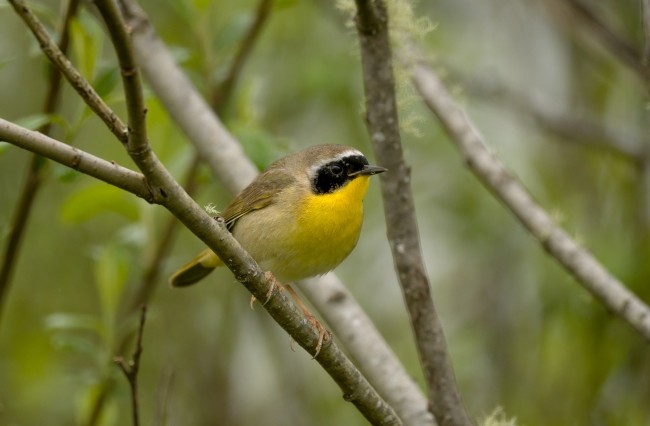 |
Sometimes known as the “yellow bandit” for its Zorro-like mask, the Common Yellowthroat (Geothlypis trichas), is a nocturnal migrant. Flying at night makes the migrating bird especially vulnerable to injury due to light pollution from urban areas and other sources. Click here to see and hear a male yellowthroat sing. Photo credit: Jake Bonello. |
That’s when Michael realized the need to get organized to address this ongoing tragedy. He and a group of other volunteers set to work creating an organization, the Fatal Light Awareness Program (FLAP), that became operational in 1993. Today, with three fulltime staff and a corps of more than 180 volunteers, most of whom are involved in bird rescue across the Greater Toronto Area, the organization has accomplished a great deal toward protecting birds in the human-built environment.
In the past 3+ decades, FLAP has recovered more than 100,000 injured and dead birds of about 178 species, including federally protected species at risk, thereby documenting the extent of the problem. FLAP has been involved in precedent-setting legal cases substantiating that killing birds with windows can be ruled a violation of environmental laws, promoted technologies to make buildings safer for birds, launched a Lights Out (at night) campaign that has spread to many more North American cities, and much more. But there is still much more to do, because wild birds are still dying by the millions every day in cities and residential neighborhoods all across the world.

Professor Daniel Klem, Jr., Sarkis Acopian Professor of Ornithology and Conservation Biology at Muhlenberg College
Through more than 50 years, Daniel Klem, Jr. has been conducting research, providing scientific advisory, and speaking out publicly about the huge problem of bird–glass collisions. Probably no scientist has devoted more of one’s life to this subject. But he originally had planned to make a career studying fish. His doctoral advisor at Southern Illinois University at Carbondale, William G. George, an ornithologist, however, encouraged him to look at birds and glass. A moving experience the very next day sealed the deal.
In his first meeting with Klem, Professor George had rather passionately told his new PhD student a story about birds flying into windows. I’ll let Professor Klem tell you in his own words about what happened next (quoting from the prologue of his 2021 book Solid Air):
“The very next morning, in January 1974 as best I can recall, I sat on a bench in front of the glass wall of the Neckers chemistry building, where Dr. George informed me window strike casualties had been collected and turned in to him. I arrived in the dark about 5 a.m. Over the next 30 to 40 minutes, the dawn light brightened enough to see the surroundings.

“Within minutes of my being able to see details, to my right, a swiftly flying bird flew through the leafless branches of a tall oak and into the upper story of the building facade. The bird appeared to be killed outright and fell to the base of the sheet glass wall. It was a Mourning Dove. I was stunned figuratively, but not literally and fatally, as the dove had been. After collecting the victim, I eagerly began a search beneath the windows of other campus buildings. This initial search revealed feather and skeletal remnants at several sites. I presumed the remains were other window-killed casualties, given their location beneath windows, and feathers, feather imprints, and body smudges on the glass surface. The strike I witnessed and these first finds were compelling evidence suggesting a topic worth further study. I was hooked.”
Although Professor Klem is encouraged by certain developments of recent years in legal protections, building codes, advances in bird-safe glass developments, and public awareness, a frustration throughout his long career has been the generally slow recognition of the problem’s seriousness and steps to address the situation in the scientific, construction, and even environmental communities.
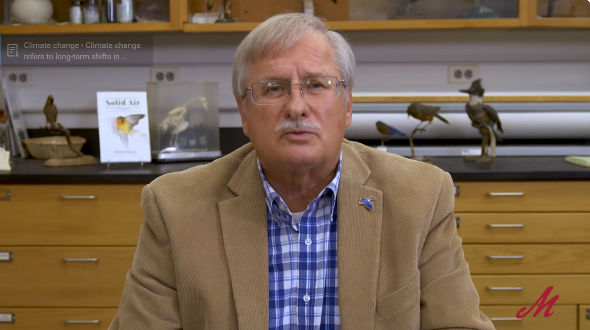 |
Muhlenberg College Professor Daniel Klem, Jr. explains the conservation issue that is billions of birds dying by collisions with windows is one that practically every person on the planet can and should help to address. In a short video, Saving Billions of Birds from Windows, he summarizes what we can do. |
He recalls a story from the 1998 North American Ornithological Conference, held in St. Louis, Missouri, where he was to make an oral presentation entitled “Glass: A Deadly Conservation Issue for Birds.” His intent was to challenge his professional colleagues to give this subject the attention he felt the problem merited:
“On purpose, I prepared no visual aids to distract the audience from the question. I did, however, expect to acquire some visual material at the meeting site by searching beneath the windows of the hotel or nearby buildings… My search produced a strikingly attractive male Red-winged Blackbird in fresh plumage at the base of one of the hotel windows, facing the Mississippi River. I also discovered a Yellow-bellied Sapsucker beneath a large storefront window across the street from Bush Stadium, where the St. Louis Cardinals baseball team played.

“Prior to beginning my scheduled talk, I laid these specimens before the audience, and explained that, except for these window-killed specimens, I had no other visual aids. I emphasized that I was there simply to ask: ‘Given what we now collectively know about avian mortality from striking windows, why is there so little concern?’”
After his no doubt heartfelt and scientific spoken presentation, Klem recalls, his audience was silent. No comments, no questions. Later, one former professor commented to Klem that he should have had more visual aids.
Public and professional apathy have not, however, kept Klem from pursuing his work. Some of his earliest experimental work contributed to the 2” × 2” and 2” × 4” rules (discussed above) that transform glass into a visible barrier that birds will see and avoid. Klem’s hope is that acid-etched and ceramic-fritted bird-safe glass manufactured in accordance with these rules will regularly be used today and in the future for new installations. Klem has also done extensive work on what he terms “the elegant solution” whereby UV signals, visible to birds but not to humans will be incorporated directly into glass.
As the result of Klem’s work and that of a few like-minded colleagues, as well as the efforts of dedicated activists, bird lovers, and others, as described in this essay, the means exist to vastly reduce this daily carnage against innocent and unknowing victims. Unfamiliarity, silence, and apathy are the invisible human barriers needing to be overcome.
| For more information
To learn more about bird–window collisions and their prevention, the related science, public awareness efforts, and organizations working to protect birds, I encourage you to browse the following resources by clicking on the links provided. Preventing bird–glass collisions
Science
Public awareness
Organizations for bird lovers
|
Gale A. Kirking is the founder of BlueGreen, a communications and consulting boutique created to help businesses and other organizations in formulating sustainability documents, designing and creating SDGs communications, and maximizing their sustainability impacts. He is a former journalist, a Chartered Financial Analyst, and an investment professional with a strong orientation to responsible investing. A United States citizen, Kirking has run a specialty communications business in Central Europe for more than 20 years. Unless otherwise explicitly indicated, the opinions expressed in this essay are his own.